Tracked Stairway Mobility Manufactured by COMPAW
As a Wholesale Electric Stair Climbing Wheelchair, Powered Mobility Chair with Tracked Drive System for Stairway Access Suppliers, Exporter, Company, we match product configuration to the application, operating limits, interfaces and acceptance criteria defined for each project.
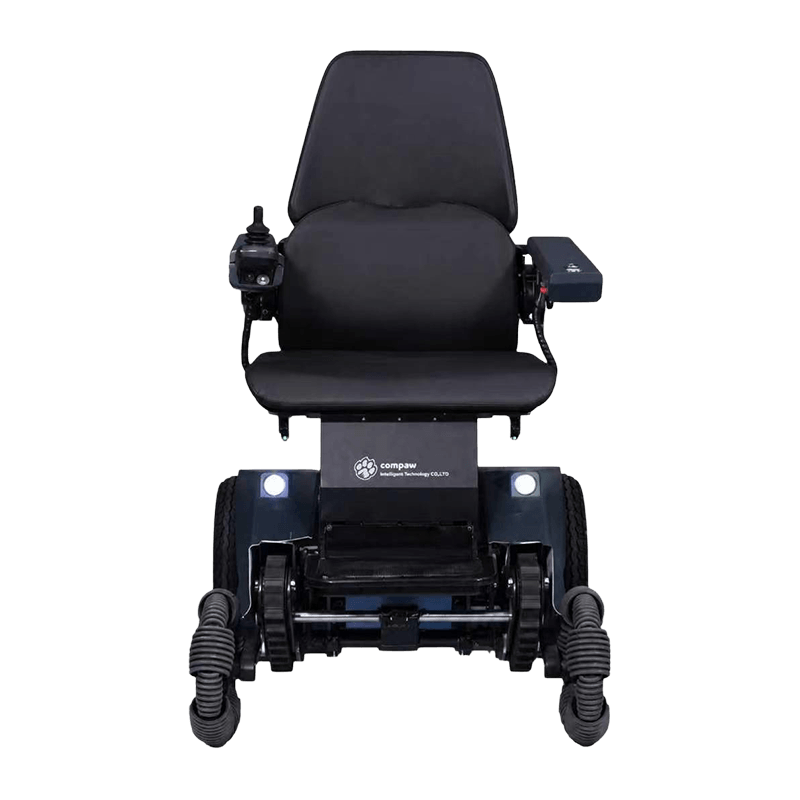
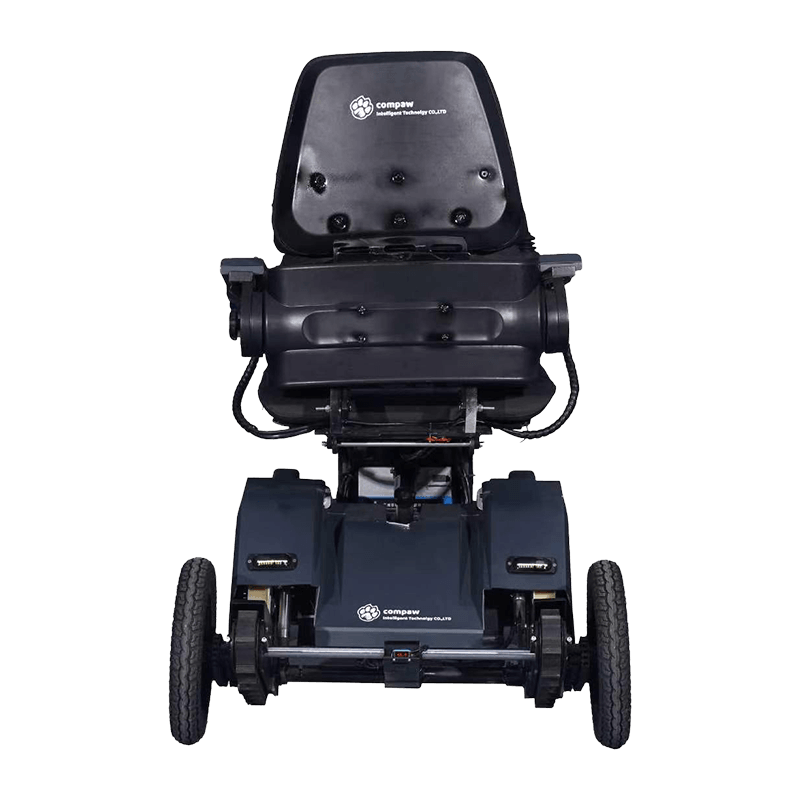
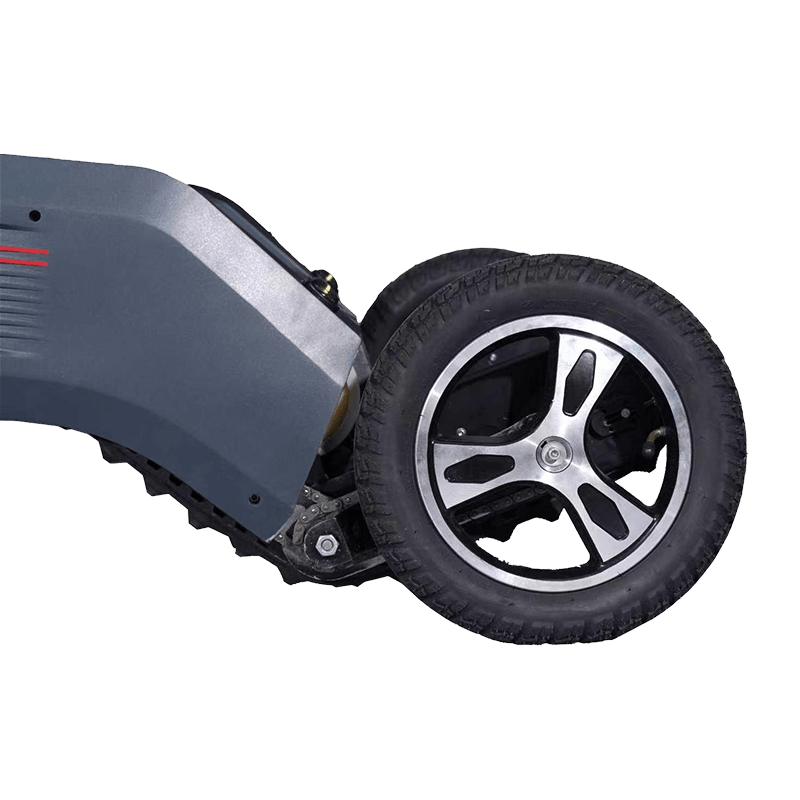
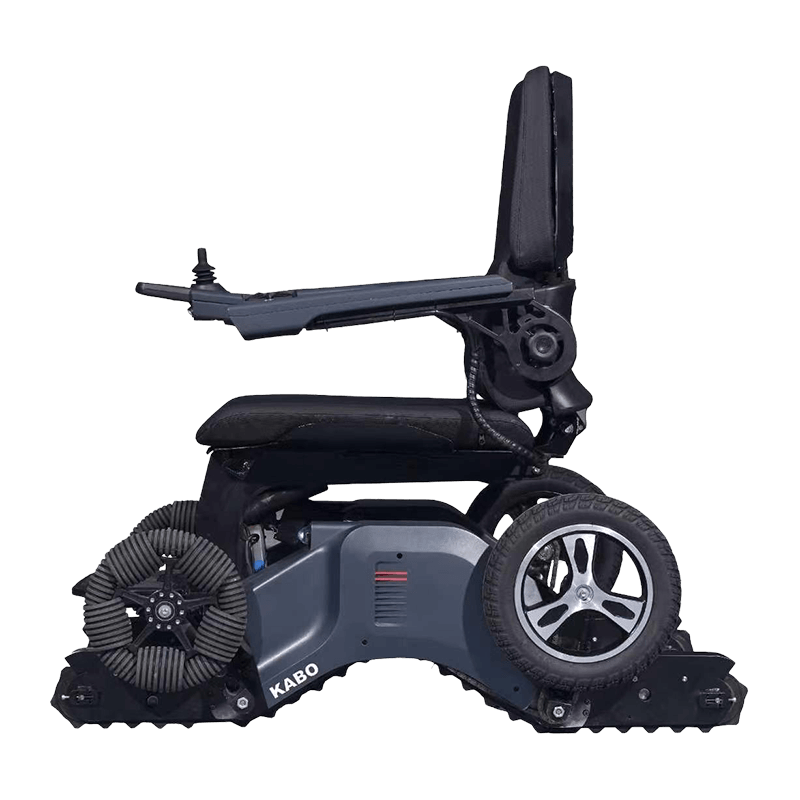
The Electric Stair Climbing Wheelchair, Powered Mobility Chair with Tracked Drive System for Stairway Access is manufactured by SUZHOU COMPAW INTELLIGENT TECHNOLOGY CO., LTD. in Suzhou, China. It is an electrically powered mobility platform built around stairway movement rather than level-ground travel alone: a tracked drive transfers force through continuous track contact, while the seat, backrest, armrests, footrests, power drive and control system are integrated into one dedicated stair-access configuration.
As a manufacturer of intelligent rehabilitation aids and accessible mobility equipment, we supply this model to rehabilitation centres, hospitals and care facilities, accessibility equipment distributors, system integrators and OEM/ODM programmes. Units are configured against the actual staircase, the user load and the operating routine rather than shipped as a fixed catalogue item.
- Tracked stair-climbing drive with continuous stair-surface contact
- Electric power assistance that reduces manual pushing and lifting by attendants
- Two operating modes: stair-climbing and flat-ground
- Remote-control operation with a 5 m control distance
- Project-based specification of seating, control and drive components
How the Tracked Drive System Works on Stairs
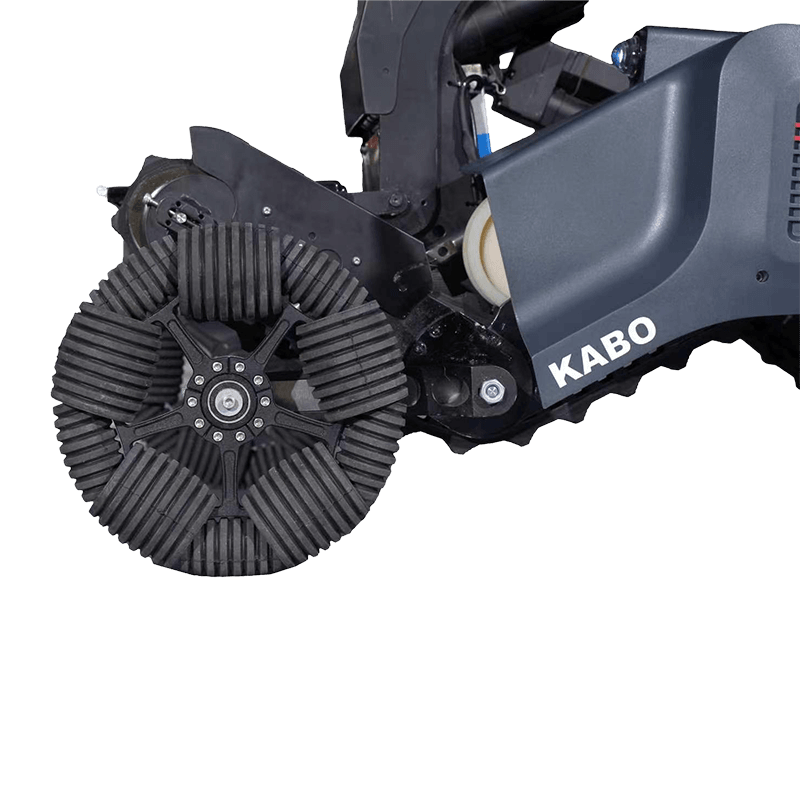
Conventional electric wheelchairs are configured for level surfaces, so their wheel contact geometry is not designed for riser-to-tread transitions. On this model, the powered track maintains a continuous bearing surface across the stair nose and tread, transferring drive force along the flight instead of relying on wheel diameter. The mechanical package — track frame, support structure, braking system and centre-of-gravity layout — is coordinated so that movement up, down and across landings stays controlled.
- Tracked configuration: continuous contact across stair surfaces during powered movement
- Powered drive: two 250 W brushless motors, 500 W combined, driving the track assembly
- Safety structure: braking, anti-slip track surface and support geometry act together during ascent and descent
- Seating integration: seat, backrest, armrests and footrests form part of the mobility structure, not add-on furniture
Technical Specifications and Operating Boundaries
| Parameter |
Specification |
| Frame material |
Aluminium alloy |
| Unit weight |
75 kg excluding the 30 Ah battery |
| Rated load capacity |
80 kg including luggage and accessories |
| Battery |
Lithium iron phosphate (LiFePO4), 24 V 30 Ah |
| Motors |
2 × 250 W brushless, 500 W total |
| Endurance |
30 km on flat ground; up to 1000 steps with the 30 Ah battery |
| Tyres |
10-inch front and rear |
| Overall dimensions |
L 1230 × W 750 × H 1100 mm; folded L 1230 × W 760 × H 620 mm |
| Transport dimension |
1150 × 730 × 630 mm with backrest folded |
| Turning diameter on the spot |
1200 mm |
| Climbing angle |
Forward < 25°; backward stair-climbing < 40° |
| Applicable stair gradient |
0°–40° |
| Obstacle surmounting |
50 mm in wheel mode; 200 mm in track mode |
| Max. stair-climbing speed |
30 steps per minute |
| Max. single-step height |
200 mm |
| Minimum landing for 90° L-shaped stair |
1200 × 1200 mm |
| Minimum passage width, straight stair |
760 mm |
| Control |
Remote control, 5 m operating distance |
| Seat adjustment |
Powered seat-height lift in seat mode |
Dual-Mode Operation and Control Interface
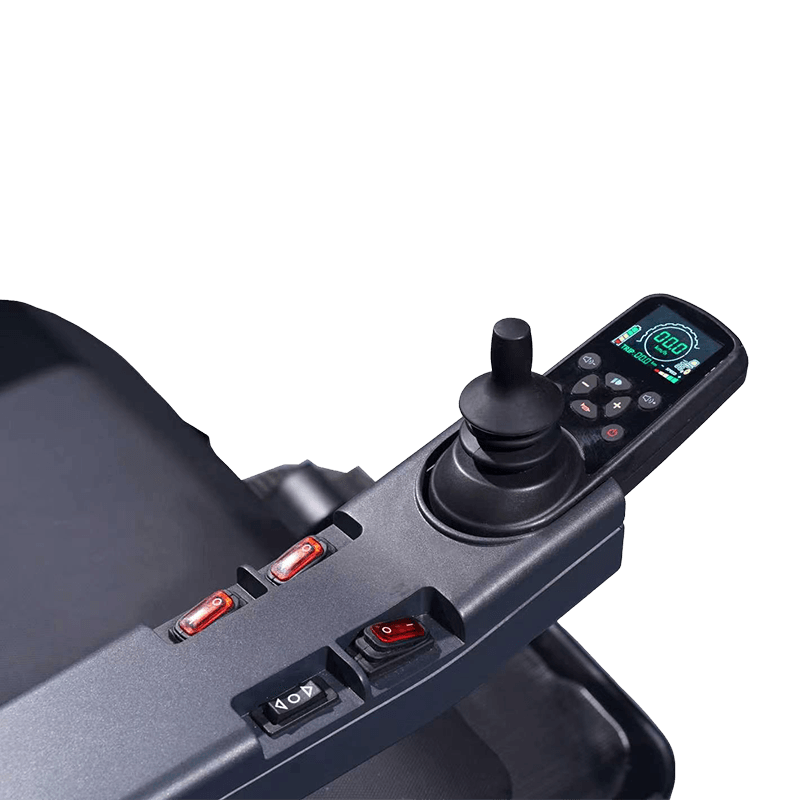
The wheelchair switches between a stair-climbing mode and a flat-ground mode, so the same unit covers the flight, the landing and the corridor afterwards. Stair movement is commanded through the remote control within its 5 m range, which lets an attendant manage ascent or descent from a position with clear sight of the track and the tread line.
- Track mode for risers and stair flights, with 200 mm obstacle capability
- Wheel mode for floors, thresholds and short outdoor approaches, 50 mm obstacle capability
- Seat-height adjustment under seat mode for transfer and positioning
- Controller layout and operating logic confirmed per order specification
Configuration Options for Projects and OEM/ODM Programmes
We treat seating geometry, control configuration and track components as order-specific variables. Distributors receiving containers for several building types, and manufacturers building their own accessibility line, work from the same configurable base; the difference lies in how far the specification is pushed in each direction.
- Seat width, seat depth, armrest type and footrest arrangement
- Track length and contact structure matched to the target stair profile
- Controller type, remote configuration and attendant-assisted operating method
- Exterior finish, branding and packaging requirements for the destination market
- Documentation language and spare-part kit composition
Information We Use to Configure Your Solution
A tracked stair climber cannot be confirmed from a product name alone. We build the proposal from the building and the operating routine, then fix the mechanical and control specification around them.
| Project input |
Why we need it |
| Riser height, tread depth, flight length |
Fixes track contact behaviour and climbing geometry within the 0°–40° range |
| Stair width, landings, turning space |
Confirms the 760 mm passage and 1200 × 1200 mm landing requirements |
| Combined user and accessory weight |
Checked against the 80 kg rated load and drive sizing |
| Daily stair cycles and trip distances |
Determines battery and endurance planning against step count and flat-ground range |
| Control and attendant routine |
Sets remote configuration and operating procedure |
| Destination market and compliance scope |
Guides documentation, labelling and local certification adaptation |
| Packaging, quantity and shipping terms |
Sets the folded transport dimension plan at 1150 × 730 × 630 mm |
Manufacturing, Quality Control and Project Handoff
Production runs in a 50,000 m² facility with more than 300 employees, built on 25 years of manufacturing experience and a 100-ton production capacity. More than 70% of our output is exported, which keeps the assembly and inspection routine aligned with international standards across every batch.
- Incoming and in-process control: frame, track assembly, motor and battery checks through the build sequence
- Functional verification: mode switching, remote response, braking behaviour and seat lift before packing
- Project coordination: specification sign-off, sample confirmation where required, and shipment documentation
- Market adaptation: support with EU, North American and other regional compliance requirements
Installation, Commissioning and Maintenance Support
The unit arrives assembled and folded to the transport configuration. Commissioning focuses on the actual stair: confirming the approach, the landing turn, the attendant position and the mode-change points before the first resident or patient is carried.
- Operator and attendant training covering mode selection, remote handling and safe boarding
- Battery charging routine and LiFePO4 pack care guidance
- Scheduled technical inspection and equipment calibration for care and rehabilitation environments
- Spare-part supply, multilingual technical documentation and remote troubleshooting for channel partners
Our Related Stair-Climbing and Wheelchair Range
The tracked stair-climbing wheelchair sits inside a wider stair and mobility portfolio, so a project can be equipped for different building types and user groups from one supplier. For sites that specify a purely tracked platform, see our China Tracked Stair-Climbing Wheelchair Manufacturers range; for attendant-led patient movement in care homes and hospitals, the China Nursing Stair Climber Manufacturers line covers routine transfers. Where a facility also needs conventional level-ground transport, our China Electric Wheel Chairs Manufacturers range provides the powered companion unit.
Frequently Asked Questions
Which stairways can this tracked stair-climbing wheelchair handle?
The drive is rated for stair gradients from 0° to 40°, single-step heights up to 200 mm and a climbing speed of up to 30 steps per minute, with forward climbing under 25° and backward stair-climbing under 40°. A straight stair needs at least 760 mm passage width, and a 90° L-shaped turn needs a landing of at least 1200 × 1200 mm; the on-the-spot turning diameter is 1200 mm. Stair geometry is checked against these values before a unit is released for a specific building.
What load can the wheelchair carry?
Rated load capacity is 80 kg, calculated to include luggage and accessories, not the occupant alone. The unit weight is 75 kg without the 30 Ah battery, and the aluminium alloy frame carries the seating and track assembly.
How far does it travel on one charge?
With the 24 V 30 Ah lithium iron phosphate battery, endurance is 30 km on flat ground or up to 1000 steps in stair use. The two 250 W brushless motors provide 500 W combined, and real duty depends on the mix of stair flights, landings and flat segments in the daily route.
Can it also be used on flat ground?
Yes. The wheelchair runs in two modes: stair-climbing mode for flights and flat-ground mode for corridors, thresholds and paved approaches. Obstacle surmounting is 200 mm in track mode and 50 mm in wheel mode, and the seat height can be lifted electrically in seat mode to assist transfers.
Can seating, controls and branding be adapted for OEM/ODM programmes?
We work through product definition with modular solutions on seating dimensions, footrests, armrests, controller configuration, track components, exterior appearance, packaging and documentation. Programme requirements are agreed in the definition phase so the specification, market documentation and packing match the destination market.
What information do you need to prepare a configuration and quotation?
Send the stair riser height, tread depth, flight length, stair width, landing and turning space, the combined occupant and accessory weight, the expected daily stair cycles, the preferred control and attendant routine, the destination market and compliance scope, plus packaging, quantity and delivery terms. With those inputs we confirm the mechanical configuration, control set, documentation and shipping plan for the model.

 English
 русский
 Español
 Deutsch