English
 русский
 Español
 Deutsch

Content
- 1 The Short Answer: Settle the Fit First, the Material Second
- 2 What "Aluminum" Actually Tells You
- 3 What "Ergonomic" Actually Tells You
- 4 Side-by-Side Comparison for Buyers
- 5 Weight Ratings and Where Aluminum Reaches Its Limit
- 6 The Five Measurements Buyers Most Often Get Wrong
- 7 Matching the Chair to Daily Use
- 8 Adjustability, Weight, and the Cost of Adjustment
- 9 A Buyer's Checklist Before Ordering
Two manual wheelchairs can sit side by side in a showroom, look almost identical, and still behave very differently at a doorway, a curb cut, or a ten-degree ramp. One is sold as an aluminum manual wheelchair, the other as an ergonomic manual wheelchair. The labels sound like competing categories, which is exactly why buyers get stuck. They answer different questions: one describes the frame, the other describes the fit.
The Short Answer: Settle the Fit First, the Material Second
Start with ergonomics, then choose the frame material that delivers it. Ergonomic geometry decides how much force your shoulders, wrists, and trunk absorb on every push. Frame material decides how much mass you have to move around. A 13 kg aluminum chair with a seat 5 cm too wide will still be harder to propel than a properly fitted chair that weighs 1.5 kg more.
Buyers who reverse that order run into one of two problems. They buy the lightest aluminum chair available, then add a cushion, a back support, and anti-tip hardware until the weight advantage is gone. Or they buy a highly adjustable ergonomic chair and discover that every adjustment point adds hardware, flex, and something else to maintain.
The workable rule is simple. Lock in seat width, seat depth, seat-to-back angle, and rear-wheel position first. Those four numbers drive comfort and push efficiency. Only then compare aluminum, titanium, steel, or carbon fiber on weight, price, and service life.
What "Aluminum" Actually Tells You
Aluminum describes the frame tubing and nothing more. Most aluminum manual wheelchairs use 6061 or 7001 series tubing, welded or bolted into either a folding cross-brace or a rigid frame. Aluminum resists corrosion, needs little finishing, and typically trims frame weight by roughly 30 to 40 percent compared with a steel frame of the same geometry.
The label stays silent on the numbers that decide daily comfort:
- Seat width and seat depth
- Backrest height and angle
- Center of gravity and rear-wheel position
- Camber, pushrim type, and caster size
- Rated weight capacity and how it was measured
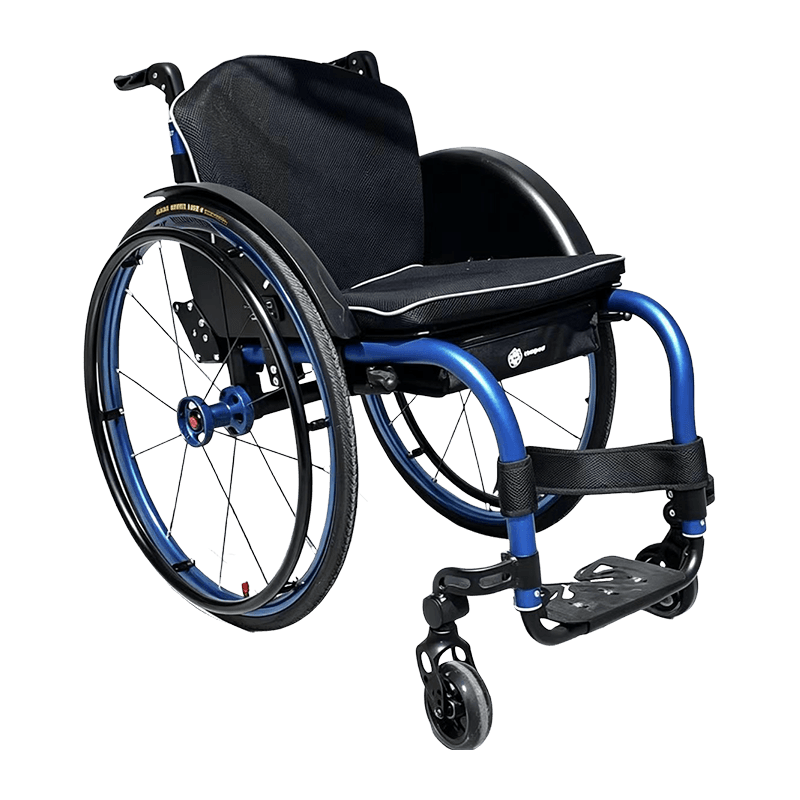
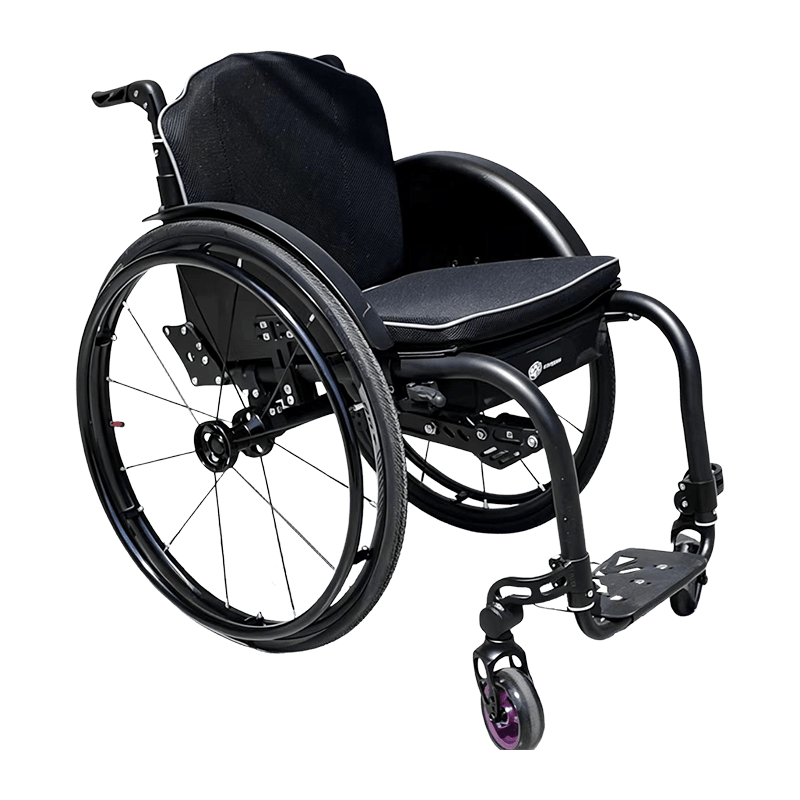 Aluminum Alloy Manual Wheelchair with Adjustable FootrestsSpecifications such as 7 kg curb weight, 120 kg capacity, seat width and depth options, and adjustable footrests clarify comfort and fit beyond a generic aluminum label.View Product →
A chair advertised as aluminum can be a 10 kg rigid frame or a 20 kg folding model with a padded sling seat. Both descriptions are accurate. Which one suits a given user depends entirely on the numbers the label leaves out.
What "Ergonomic" Actually Tells You
Ergonomic refers to the interface between the user and the chair: seat cushion and contour, backrest shape, seat-to-back angle, armrest height, and how far the center of gravity can be tuned toward a natural push stroke. Ergonomic design is a set of adjustments, not a material. The same geometry can be built on aluminum, titanium, or carbon fiber.
Two ergonomic features matter more than the rest. The first is seat-to-back angle. A slightly open angle, roughly 95 to 100 degrees, reduces posterior pelvic tilt and keeps the shoulder in a stronger pushing position. The second is rear-wheel position relative to the shoulder. When the axle sits slightly forward of the shoulder joint, the push arc shortens and the force required per stroke drops noticeably.
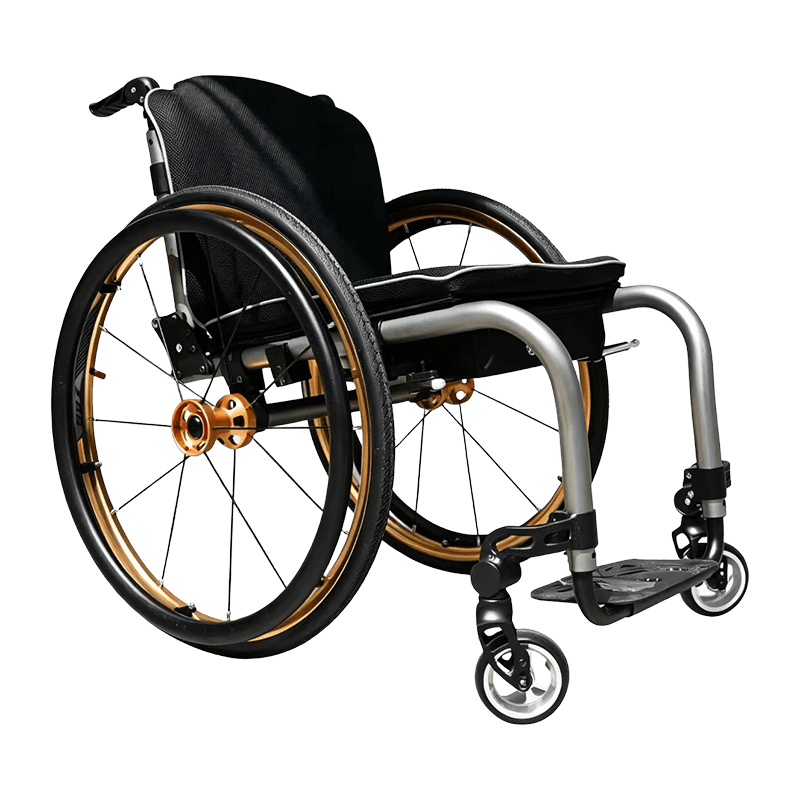
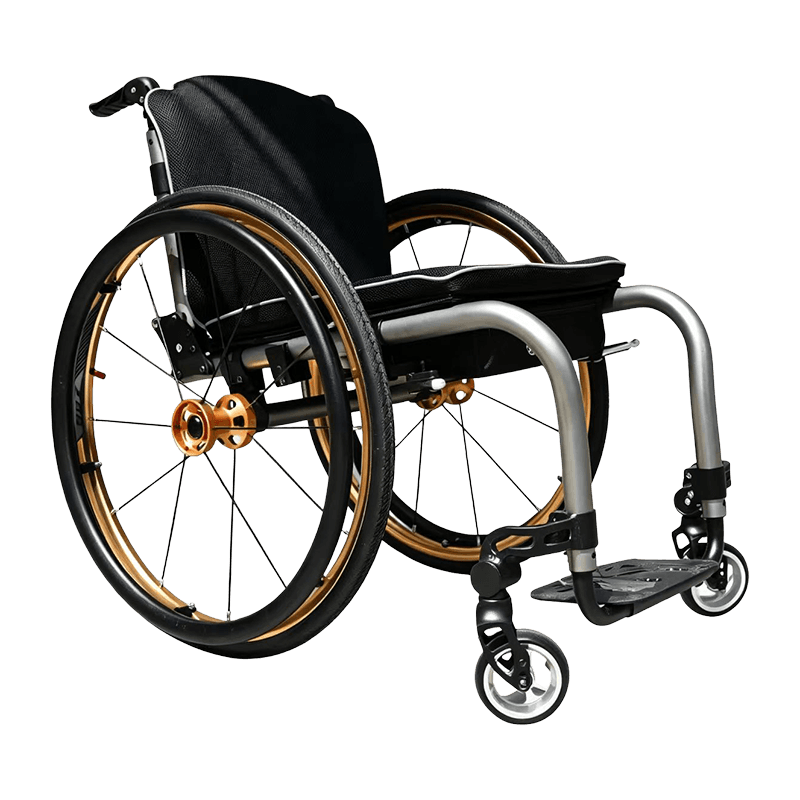 Titanium Alloy Ergonomic Self-Propelled Manual WheelchairA 7.2 kg titanium frame with 120 kg capacity and adjustable footrests supports ergonomic fit considerations such as seat-to-back angle and rear-wheel position.View Product →
Titanium enters the discussion because it has a higher strength-to-weight ratio than aluminum, so an ergonomic frame can be stiff and light without extra wall thickness. The trade-offs are price, longer lead times, and fewer stock sizes.
Side-by-Side Comparison for Buyers
The table below reflects typical mid-range configurations rather than extremes. Use it to identify which question you are actually answering.
| What buyers compare | Aluminum-focused manual wheelchair | Ergonomic-focused manual wheelchair |
|---|---|---|
| Design priority | Low frame weight, corrosion resistance, low maintenance | Posture support and an efficient push stroke |
| Frame material | Aluminum alloy, commonly 6061 or 7001 | Any material; frequently aluminum or titanium |
| Typical frame weight | 10 to 14 kg lightweight, 15 to 20 kg standard folding | 9 to 16 kg depending on adjustment hardware |
| Adjustability | Limited: seat width, footrests, sometimes back angle | High: center of gravity, seat-to-back angle, camber, armrests |
| Setup before first use | Usually minimal | Requires measurement and a fitting session |
| Best fit | Transport, part-time use, caregiver pushing | Daily self-propulsion and posture requirements |
| Main trade-off | Less posture support out of the box | Higher price and more parts to maintain |
Weight Ratings and Where Aluminum Reaches Its Limit
Frame material alone does not set capacity. Tube diameter, wall thickness, weld quality, and cross-brace design do. Standard manual wheelchairs are commonly rated between 100 kg and 120 kg, while reinforced aluminum models often reach around 130 kg. Those figures assume a static seated load with the user reasonably centered.
Real use is less forgiving. Curb drops, transfers, and lateral loads during turns introduce dynamic forces several times the seated weight. A 130 kg rating on paper can still fail at the caster fork or the cross-brace hinge if the chair is regularly dropped off curbs. When a user sits close to the rated limit, choose a model with a published safety margin rather than the lightest frame in the catalogue. Tube strength and weld quality are decided on the production line, which is why our factory publishes its capacity and process details before any specification sheet is written.
The Five Measurements Buyers Most Often Get Wrong
- Seat width: measure hip width at the widest point, then add roughly 2 cm per side. Anything wider forces the user to reach outward on every stroke.
- Seat depth: measure from the back of the buttock to the back of the knee, then subtract 2 to 5 cm. Too deep, and the cushion edge presses behind the knee.
- Seat-to-floor height: determines whether both feet can plant flat and whether transfers remain realistic.
- Backrest height: should sit below the lower edge of the shoulder blade for anyone who self-propels.
- Weight with accessories: cushions, anti-tips, and bags routinely add 2 to 4 kg to the catalogue figure.
Get these five numbers right and most material debates become straightforward. Get them wrong and no frame material will rescue the purchase.
Matching the Chair to Daily Use
Frequent car transport
Folding behavior and lifted weight dominate here. A 12 kg aluminum chair that folds in one motion usually beats a stiffer ergonomic model that needs the wheels removed.
Daily self-propulsion over long distances
Ergonomics leads. Rear-wheel position, camber, and seat-to-back angle do more for endurance than a kilogram of frame weight.
Caregiver-pushed use
Push handles, brake access, and total weight matter more than fine center-of-gravity tuning, since the user is not absorbing the stroke load.
Limited upper-body strength or endurance
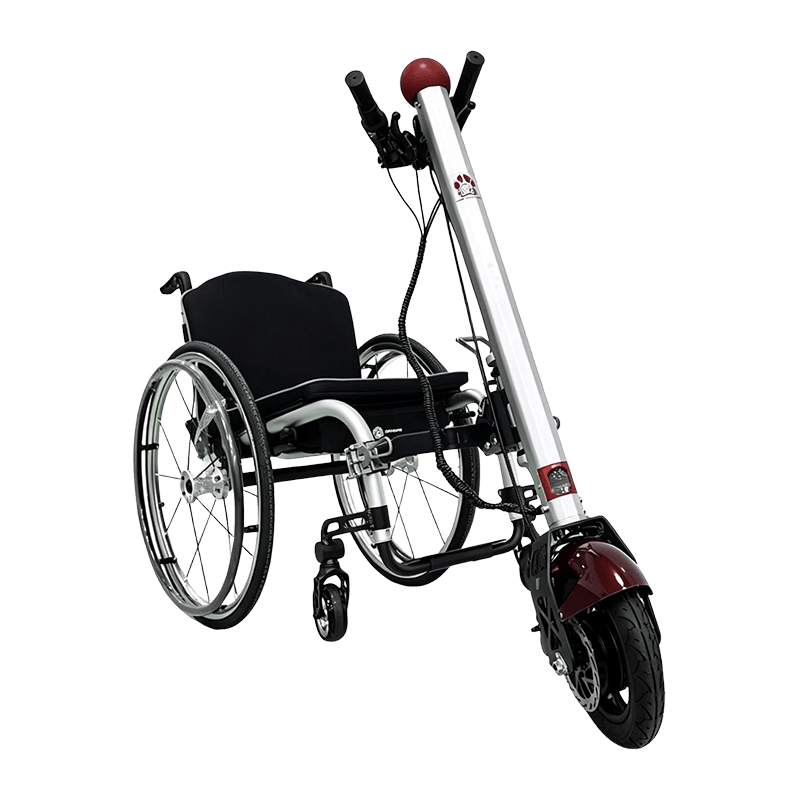
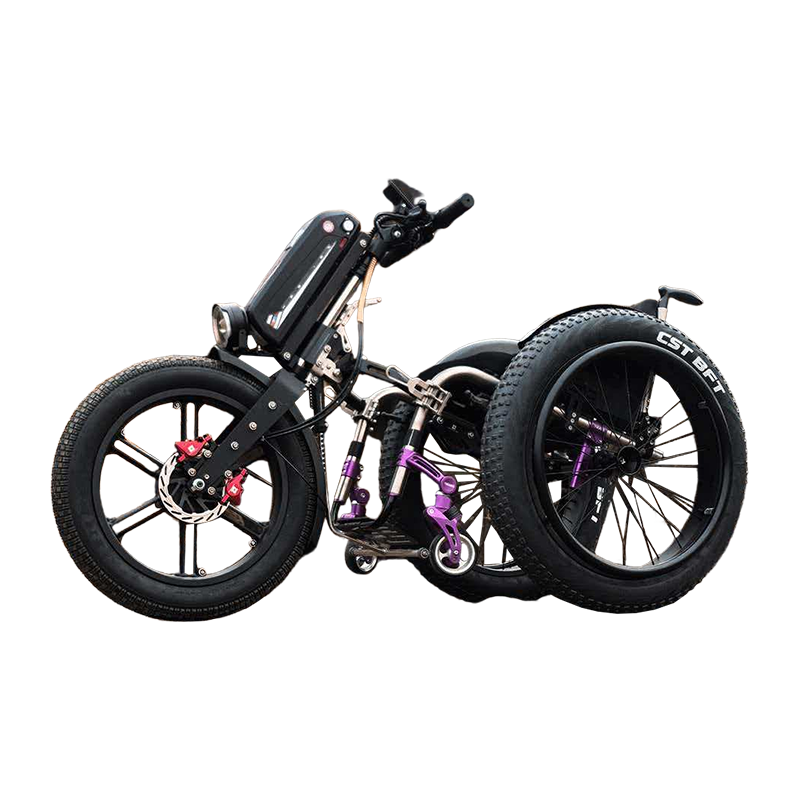
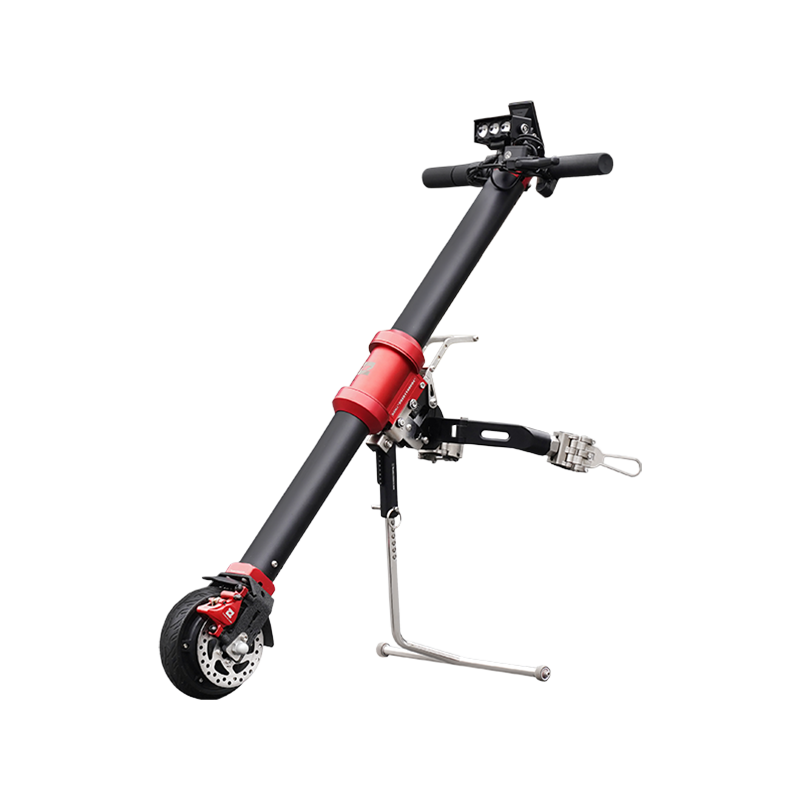
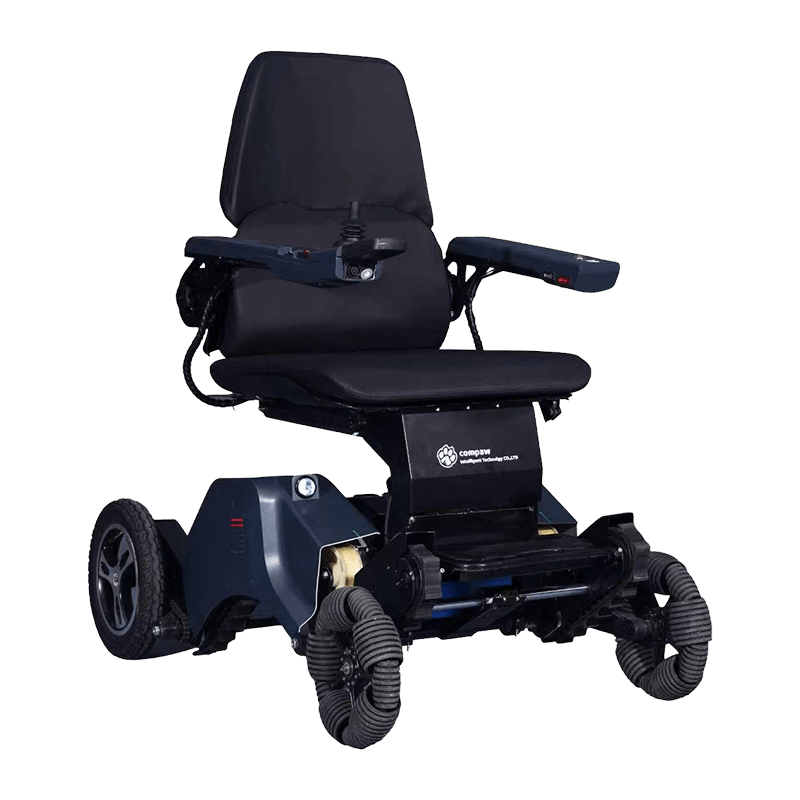
When shoulder strength is the limiting factor, the material debate may be beside the point. A manual chair can be paired with a detachable power attachment that turns it into a powered mobility device while keeping the manual chair for indoor use.
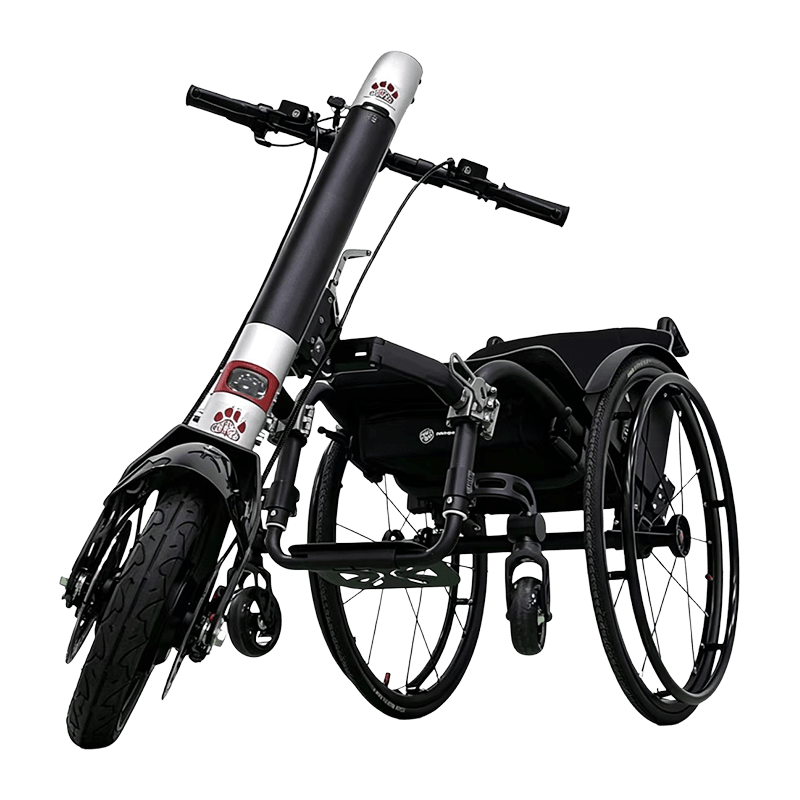
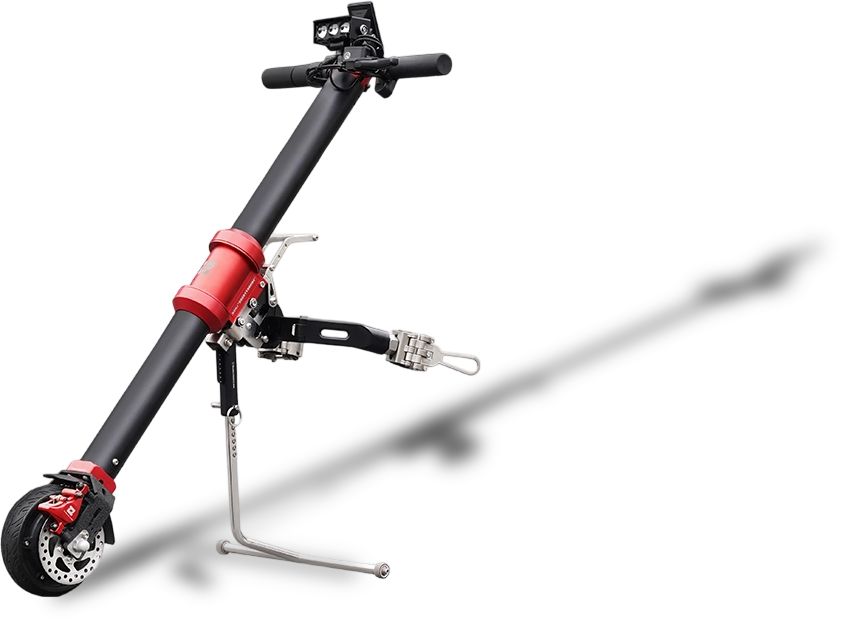
 SlimTough Quick-Connect Electric Handcycle Attachment for Manual WheelchairsAdds 350 W powered assist with 36 V battery options and up to 60 km range, useful when shoulder strength limits manual propulsion.View Product →
Adjustability, Weight, and the Cost of Adjustment
Every adjustment point adds hardware. Hinges, telescoping tubes, and extra fasteners make an ergonomic chair heavier and slightly more flexible than a welded rigid frame of the same material. That is not a defect; it is the price of fitting more than one body. A rigid frame that is welded to a single geometry can be both lighter and stiffer, but it only fits one set of measurements.
Total cost of ownership follows the same logic. Bearings, casters, brake levers, and upholstery are the parts that wear first, and their availability often matters more than the initial sticker price. Before ordering, confirm that replacement parts exist for the exact model and that the frame width is not a discontinued size. Comparing models across the full manual wheelchair range makes that check easier than comparing single units.
A Buyer's Checklist Before Ordering
- Measure the user while seated, ideally in the chair they currently use.
- Confirm weight capacity with a 20 to 30 percent margin over user weight plus carried items.
- Check the push stroke: the elbow should stay slightly bent at the end of each stroke.
- Verify serviceability, including bearings, brake components, and upholstery replacement.
- Match the folded footprint against the vehicle boot or storage space.
- Ask for delivery lead time and spare part availability for the specific model.
- Trial the chair for a full day of normal use, not a showroom lap.
Aluminum and ergonomics are not rivals. Aluminum is one answer to the frame question; ergonomic design is the discipline of fitting a chair to a body. Buyers who settle the fit first and the material second end up with a chair they can push comfortably for years. Buyers who shop by material alone often pay twice: once for the chair, and again for the cushion, back support, and power assist that finally make it usable.